

Six weeks after my third was born I stood in a physio’s room in Fremantle with my shirt pulled up while she pressed two fingers into the gap above my belly button and said “yeah, that’s about two and a half.” I’d had a caesarean this time (the first two were the regular way) and I’d been doing precisely nothing for six weeks except feeding, walking to the letterbox and lying on the couch wondering if I’d ever run again.
Her name is Dani. She’s a women’s health physio who’s been working out of a clinic near the South Fremantle markets for about nine years and she’s seen, by her own estimate, a couple of thousand postpartum tummies. So I asked her the question every mum asks. When can I start?
“You already have,” she said. “You walked here.”
She had a point. I’d pushed the pram from the car park. It didn’t feel like exercise. That turned out to be the whole point.
Where “start” is
There’s a date that lives in most mums’ heads and it’s the six-week check. Get the tick from the GP or the obstetrician and off you go. Dani doesn’t love that number. She says it’s fine as a rough marker for an uncomplicated vaginal birth with no tearing, but it’s too early for a lot of caesarean mums and too late for the gentle stuff that most women could be doing from the first fortnight.
The gentle stuff is walking, breathing properly (more on that in a minute) and pelvic floor work. Not the gym and not a jog around Lake Monger or the online bootcamp your sister-in-law swears by. Those come later and how much later depends on you, not the calendar.
The pelvic floor comes before everything else
If you take one thing from this whole piece, take this. Your pelvic floor has been holding up a growing baby for the best part of nine months and if you delivered vaginally it’s been stretched in a way that most people wouldn’t ask of any other muscle without a rehab plan. Running, jumping and anything with impact loads it hard. Do that before it’s ready and you can end up with leaking, heaviness or a prolapse that takes far longer to fix than the few weeks you saved.
The exercise itself is dull. Squeeze as though you’re stopping wind and wee at the same time, lift gently, hold for a few seconds, let go completely. Ten of those, three times a day. In the car at the lights, feeding at 3am, standing at the kettle waiting for it to boil. Nobody can see you doing it. That’s the one upside.
Pelvic Floor First (that’s the Continence Health Australia site) has a good plain-English guide to returning to sport or exercise after birth. It’s written by physios, it’s free and it doesn’t try to sell you a program. Dani sends every client there.
Eating enough, the bit nobody mentions
Here’s the bit I got wrong for the first two babies and only sorted out on the third.
You can’t rebuild anything on toast. Breastfeeding alone burns something like 500 extra calories a day and the protein target for a feeding mum who’s also starting to move again is a good deal higher than most of us hit. Dani’s rough rule is a palm-sized serve of protein at every meal and something with protein in it at each of the snacks you’re grabbing one-handed. Eggs, yoghurt, tinned tuna, leftover chicken, a handful of nuts.
On the days when that’s not happening (and there’ll be plenty) a shake is the lazy fix. I kept a whey protein powder from an Australian retailer in the pantry through the whole first year with number three and I’d mix a scoop into milk while the bottle was warming for the older two. No magic in it, just protein that needs no cooking and no plate. Check the label for a short ingredient list and pick a plain vanilla or chocolate; the fancy flavours get old fast.
If you’re breastfeeding and unsure about anything you’re taking, ask your GP or a lactation consultant. Whey’s a milk protein and it’s fine for most people but “most” isn’t “all.”
The ab gap
That two and a half centimetres Dani found is called diastasis recti. Abdominal separation, if you’d rather. The two halves of the six-pack muscle drift apart during pregnancy to make room and in a lot of women they don’t come all the way back on their own. Not dangerous, but it does put sit-ups, crunches and planks off the list for a while since they push the gap wider.
What Dani had me doing instead, from about week seven:
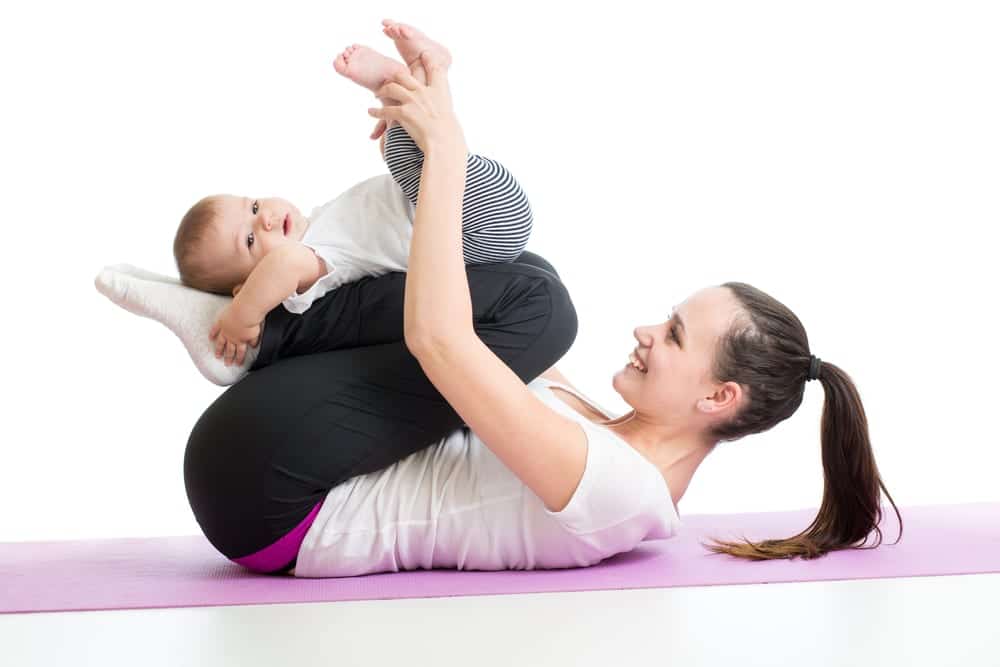
Diaphragm breathing, lying on my back with knees bent. Breathe into the sides of the ribs, let the belly soften on the way in and draw it gently toward the spine on the way out. Ten slow breaths. Feels like nothing. Isn’t.
Heel slides. Same position, engage the pelvic floor and lower belly, slide one heel away along the floor until the leg’s nearly straight, bring it back. Alternate. Ten each side.
Bent-knee fallouts. Knees bent, feet flat, let one knee drop slowly out to the side while the hips stay dead still. The stillness is the exercise. Ten each side.
Glute bridges. Push through the heels, lift the hips, squeeze at the top, lower with control. Ten to fifteen.
That’s the whole program for the first month or so. Under fifteen minutes. You can do it on the rug while the baby’s on the play mat next to you and the older kids climb on your legs. That’s how most of mine got done.
Caesarean, specifically
If you’ve had a section the scar needs to heal before you load anything through the front of the body. Dani’s guide was walking only for the first six weeks, then the floor work above once the wound was fully closed and the GP was happy, then no lifting heavier than the baby for another month after that. Roughly twelve weeks before anything that looks like a workout. Longer if there were complications.
The scar also benefits from gentle massage once it’s healed, moving the skin around in small circles to stop it sticking to the layer beneath. Nobody mentioned this to me after my section. Dani did. It made a noticeable difference to how it felt to twist and bend six months on.
Getting out of the house
Once the basics are in place the best exercise in Perth for a new mum is a walk with the pram somewhere flat and pretty, ideally with a coffee at the end and other adults to talk to. Lake Monger is the obvious one, about 3.5 km around and busy enough on a weekday morning that you’ll see other prams. South Beach at Fremantle is good early before the wind gets up. Bibra Lake has a boardwalk and a decent playground for when the older kids are with you.
Buggybuddys has a whole guide to pram-friendly walks in Perth that covers the river, the coast and the lakes, so I won’t repeat it here.
Mums and bubs classes are the next step for a lot of women, partly for the exercise and partly because you get to be around people who also haven’t slept. Look for one run by a physio or a trainer with a postnatal qualification. If the instructor has you doing burpees in week eight, leave.
Where I got to
I ran again at about five months. Slowly, along the path at South Beach, with the pram, for about twelve minutes before something in my pelvis said that’s enough for today. Dani had told me it’d feel like that. It did. A month after that it was twenty minutes and the feeling had gone.
I never got back the flat stomach I had at twenty-six. I did get back the ability to pick up a toddler from the floor without bracing for it and to chase a four-year-old across the oval at Fremantle Park without leaking. Three kids in, that feels like the better deal.
- About the Author
- Latest Posts