
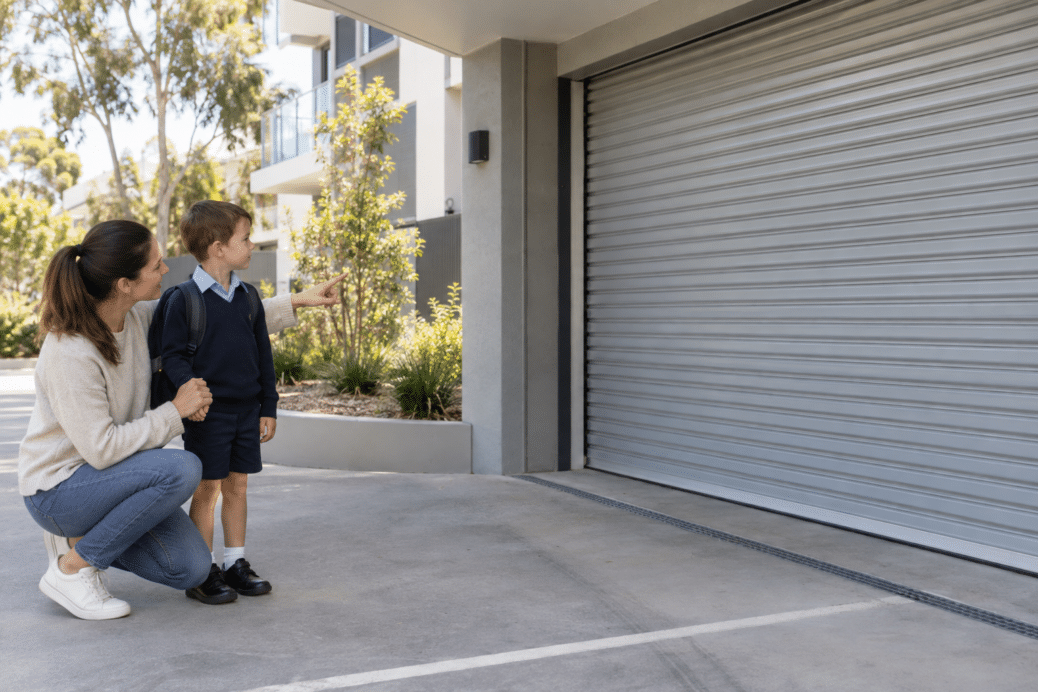
If you live in an apartment, shop at a big centre or park under an office block, your family passes under a powered roller door or car park shutter more often than you might think. Most of us never give them a second look. They open, they close and we drive through.
Kids, of course, notice everything. A big door that rolls up by itself is fascinating to a three-year-old. A gap under a closing shutter looks like a challenge to a seven-year-old on a scooter. And a car park entry is a busy, noisy place where drivers are watching the boom gate, not the footpath.
We are Glide Roller Doors, a commercial door company in Welshpool. We look after the doors and shutters on shopping centres, strata car parks, schools and warehouses across Perth. We do not work on home garages, but we spend a lot of time in the places families go every day. Here is what we would like every parent to know.
How These Doors Work, in Plain English
A roller door is a curtain of steel slats that winds up onto a drum above the opening. A strong spring inside the drum helps balance the weight, and on most commercial doors a motor does the lifting and lowering.
Car park doors in apartment buildings are often roller doors or panel doors that lift up and slide back along the ceiling. Shopping centres use roller shutters on loading docks, service areas and sometimes shopfronts.
These doors are big and heavy. A car park door might weigh far more than a car door, and it moves on its own when someone presses a remote. That is why modern doors have safety devices.
The Safety Features That Should Be There
Most powered commercial doors have two main safety features:
- Safety beams. Small sensors on each side of the opening send an invisible beam across the doorway. If something breaks the beam while the door is closing, the door should stop and go back up.
- Auto-reverse. If the door touches something on the way down, it should stop and reverse.
When these work, they are very good at preventing accidents. The catch is that they can stop working without anyone noticing. A beam gets knocked out of line. A setting drifts. The door still opens and closes every day, so nobody realises it would no longer stop for a child.
We have seen it ourselves. When we took over maintenance at a large shopping centre in Cannington, we found the auto-reverse was not working properly on two doors. Nobody had noticed, because the doors were still opening and closing normally. That is why regular safety testing matters so much.
Simple Rules for Kids
You do not need to make children afraid of doors. A few simple rules, practised a few times, go a long way.
- Never run under a moving door. Not up, not down, not even if it looks like there is time.
- Doors and remotes are not toys. Remotes and wall buttons stay with grown-ups.
- Stay on the footpath at car park entries. Cars come and go quickly, and drivers may not see small people.
- Never ride a bike or scooter through a car park door. Walk with a grown-up instead.
- If a door makes a funny noise or moves strangely, move away and tell a grown-up.
For younger kids, turning the rules into a game helps. “Doors are for cars, footpaths are for feet” is easy to remember and easy to say every time you go through.
For Parents Living in Apartments
If your building has a car park door, it is shared property, and the strata company is responsible for looking after it. Under Western Australia’s Strata Titles Act 1985, the strata company must maintain common property, which usually includes the car park door and its motor.
As an owner or tenant, you can help keep it safe:
- Watch how the door behaves. If it stops and goes back up for no reason, slams down, makes grinding noises or seems slower than usual, tell your strata manager.
- Test the safety beam safely. Do not test it yourself with a child or a body part. Report any concerns and let a technician check it.
- Ask when it was last serviced. Strata committees should be able to tell you. Most busy car park doors need servicing more than once a year.
- Keep remotes secure. A lost remote is a security risk as well as a safety one.
- Raise it at the AGM. If the door is old or unreliable, ask the committee to get a professional assessment.
For Parents Running a Family Business
Many Perth families run a business from a warehouse, workshop or shed with a roller door. Weekends and school holidays often mean kids come to work with mum or dad.
A few habits make a big difference:
- Keep children well clear of the door when it is opening or closing.
- Keep the remote or wall button out of reach.
- Never let kids play in the doorway or ride bikes inside the building.
- Know where the manual release is, and never let anyone stand under the door while it is used.
- Never try to adjust springs or cables yourself. They hold a lot of stored energy and can cause serious injury.
School Holiday Outings and Shopping Centres
School holidays mean more trips to shopping centres, cinemas and indoor play centres, and more time in busy undercover car parks. These are some of the most hectic places for families, with cars reversing, trolleys rolling and kids excited about what is coming next.
A few habits make outings safer:
- Hold hands from the car to the lift. Car parks are tight spaces with lots of blind corners.
- Steer clear of service areas. The big roller shutters at the back of shops and food courts are for deliveries. Loading docks are busy places with trucks and forklifts.
- Look for the footpath. Most car parks have a marked walkway. Use it, even if it is a little longer.
- Watch for the car park door. In smaller centres and office buildings, the car park entry may have a roller door or shutter that closes behind each car. Never follow a car through on foot.
Older Kids, Bikes and Scooters
Once children start riding to school or to a friend’s place, they pass through more shared spaces on their own. Apartment kids in particular may ride in and out through the building’s car park.
Talk to older children about:
- Getting off and walking a bike or scooter through any car park door or gate.
- Waiting until the door is fully open and still before going through.
- Never trying to beat a closing door, however close it looks.
- Never hanging off, climbing on or pushing a door or shutter.
- Telling you if a door at the building, school or shops behaves strangely.
Older kids often understand rules better when they understand why. Explaining that the door is heavy and its safety sensors can sometimes fail is usually enough to make the point without frightening anyone.
Signs a Door Needs Attention
Whether it is at home, at school or at the shops, these signs suggest a door needs a technician:
- It is louder than usual, or grinds, squeals or shudders.
- It moves unevenly, or one side drops faster than the other.
- It stops and reverses when nothing is in the way.
- It closes fast or slams.
- The curtain is dented or bowing out of its tracks.
If you notice any of these at a shopping centre or school, let the centre management or front office know. They will usually be grateful for the heads up.
If Something Does Go Wrong
If a door hits someone or traps a hand or foot, stop the door first if you can do it safely, using the button or remote that operates it. Do not try to force a heavy door up by hand. Call Triple Zero (000) for an ambulance if anyone is hurt, and let the centre management, school or strata manager know straight away so the door can be taken out of use and checked before anyone else goes near it.
How Often Should These Doors Be Serviced?
As a rough guide, most commercial doors used every day are best serviced twice a year, and busy car park doors may need a service every three months. Each service should include testing every safety device and writing down the results.
Strata managers and business owners who want to know what a proper roller door service in Perth includes can find a full checklist from Glide Roller Doors here.
The Takeaway
Powered doors are safe when they are well maintained and used with a bit of common sense. Teach your kids a few simple rules, keep an eye on the doors in your building, and speak up when something seems wrong. It only takes a minute, and it helps keep every family in the building safe.
- About the Author
- Latest Posts