

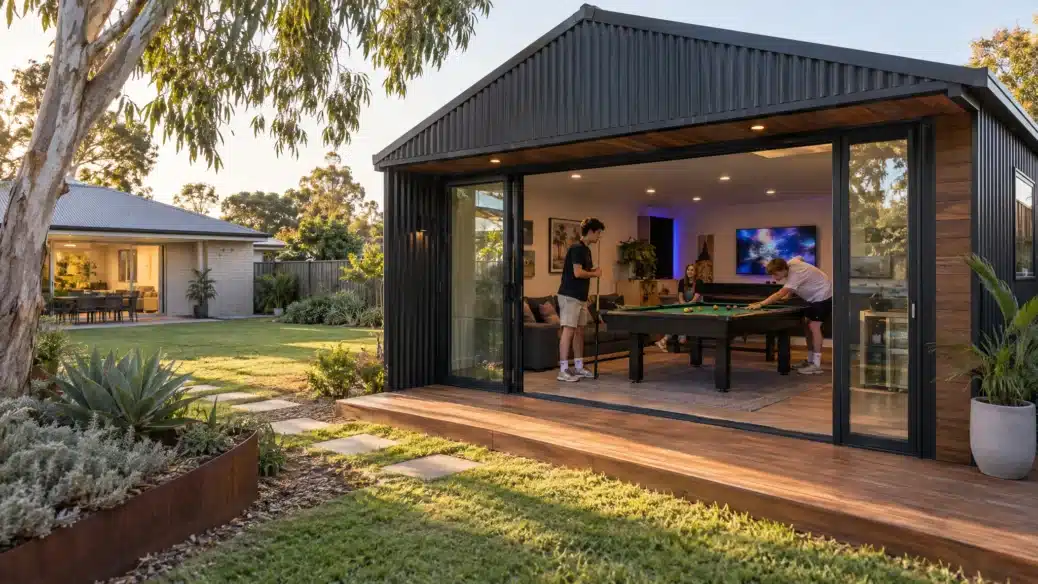
Every Perth parent knows the moment. The kids who once happily played in a cubby house are now taller than you, and suddenly the lounge room is too small, too loud and too close to the adults. Tweens want somewhere to play games with mates. Teenagers want somewhere to practise guitar, stream a film or simply close a door.
A backyard shed is one of the most practical answers to that problem. It gives young people a space that is theirs, keeps the noise and the mess out of the main house, and costs far less than a home extension. This guide walks through the decisions in the order you will meet them, from deciding what the space is for to setting the house rules once it is finished.
Why a Separate Space Works So Well for Older Kids
Children between ten and seventeen are building independence, and a space that sits a few steps from the back door gives them a safe version of it. They are still on your property, still within earshot and still part of the household, but they have somewhere to socialise without an audience.
There are practical benefits for the rest of the family too. Sleepovers move out of the lounge room, drum kits stop competing with the evening news, and the games console no longer takes over the family TV. Many parents also find it easier to host their kids’ friends, because the group has room to spread out. That only works if the space is planned around real use, which is where the next step comes in.
Plan the Layout Before You Pick Up a Tool
The most common mistake is starting with the building and working out the purpose later. Start with the purpose. Will it be mostly a games room, a band space, a study retreat or a bit of everything? A console corner needs power points and a screen position away from glare. A music space needs thicker lining to keep noise from the neighbours. A sleepover room needs floor space for mattresses and decent airflow.
Many Perth families sketch their ideas first with a shed designer online, which lets you move walls, doors, windows and roller doors around on screen before anything is ordered. It is a simple way to test whether a couch and a table tennis table can actually share the same floor, and it is far cheaper to move a window on a screen than on a finished wall. Even a rough layout of your Bayswater or Joondalup backyard, with the existing fences, trees and clotheslines marked in, will save you from nasty surprises later.
Once you have a layout, you can price it properly, and that is where many projects either gain momentum or quietly stall.
Understand the Real Costs Before You Commit
A bare shed and a finished teen retreat are very different things. The structure is only one part of the budget. Lining, insulation, flooring, electrical work, lighting and furniture all add up, and they are the items people tend to forget when they first start dreaming.
The shed cost for a lined and powered games room in a suburb such as Rockingham or Canning Vale will depend mainly on the size of the footprint, the wall height, the number of windows and doors, and how much of the fit-out you are willing to do yourself. A smaller building with good insulation will usually serve a family better than a large uninsulated one that nobody wants to use in summer.
Cost is also affected by rules. Size, height and boundary setback requirements for outbuildings vary between local governments, and some builds need approval before work begins. A quick call to your council early on is far better than finding out after the slab has been poured. The final budget should also leave room for the Perth climate, which is the next thing to think about.
Design for Perth Heat, Sun and Storms
Teenagers are not known for tolerating a stuffy room, and an untreated metal building can get very hot. In a suburb like Ellenbrook, where January afternoons regularly push past 38 degrees, the sheds Perth builds for teenagers need to be planned for heat from day one rather than fixed later with a pedestal fan.
Good insulation in the walls and roof makes the biggest difference, followed by light-coloured cladding that reflects the sun. Position matters as well. Facing the main windows away from the harsh western sun, adding eaves or a verandah for shade, and including ventilation at both high and low points will keep the air moving. A split-system air conditioner is a worthwhile addition for a room used daily, and it also helps keep electronics running smoothly.
Winter deserves attention too. Rain on a steel roof can be loud, so acoustic insulation helps if the space will be used for music or late-night movies. Once heat, noise and weather are sorted, you can turn to the structure itself, because the frame you choose affects how the whole room works.
Choose a Frame That Suits the Size of Your Plans
Most backyard builds use a standard domestic frame, which is more than adequate for a typical games room of around four by six metres. If you have a larger block, or you want a wide open floor without internal posts, it is worth looking at heavier options. Bigger properties in the Perth Hills, around Gidgegannup or Roleystone, sometimes suit the stronger framing used in industrial sheds, which can span wide areas without posts getting in the way of a pool table or a band set-up.
The trade-off is simple. A heavier frame costs more and may need a stronger slab, but it gives you flexibility. If there is any chance the building will become a workshop, a car space or a studio down the track, building a little bigger and stronger now can be wiser than starting again later. Whichever frame you choose, the interior is what your teenagers will care about, so here are the features worth prioritising.
Seven Features That Make a Teen Shed Actually Work
Once the structure is settled, these are the features that tend to separate a space that gets used every day from one that gathers dust.
- Plenty of power points. Plan more outlets than you think you need, with some at desk height and others near the floor for consoles and chargers. A few extras will cover whatever gadgets arrive next year.
- Insulation and lining. Insulated walls and ceiling keep the room comfortable and cut down on noise travelling to the neighbours.
- Proper flooring. Concrete is durable, but carpet tiles or vinyl planks add warmth and soften sound. Tiles are also easy to replace if a drink gets spilled.
- Good lighting. Dimmable ceiling lights for movie nights, plus brighter task lighting for homework, make the room flexible.
- Reliable wifi. Check that the signal reaches the shed, and consider a mesh extender or a wired connection for gaming.
- Flexible furniture. Bean bags, a fold-away table and wall-mounted shelves let the room change from a party space to a study space in minutes.
- Secure storage. Lockable cupboards keep valuable equipment safe, and a lockable external door gives you peace of mind when the shed is empty.
A room full of good features still needs boundaries, which is the part many families overlook.
Set the House Rules Early
Independence works best with clear expectations. Agree on opening and closing hours, how many friends can visit at once, and what happens to noise after a certain time. Keep the door openable from the inside, install a smoke alarm, and put a light on the path between the shed and the house so everyone can get back safely at night.
Involving your teenagers in the planning also helps. Let them choose the paint colour, the furniture layout and the posters on the wall. A space they helped design is a space they are more likely to look after, and the conversations you have along the way often matter as much as the finished room.
Think about the neighbours as well. A quick chat before the shed goes up, and an agreement about noise, will avoid friction later.
Bringing It All Together
A backyard games room is really a series of connected decisions. The purpose shapes the layout, the layout shapes the budget, the budget and the climate shape the materials, and the frame holds it all up. Get those in the right order and you end up with a space that suits your family for years, rather than a shed that never quite works.
Start small if you need to. Sketch the layout, call the council and ask your teenagers what they actually want. Perth backyards are generous, the weather is on your side for most of the year, and the payoff is a room where your kids and their friends are happy to be, just a few steps from your back door.
- About the Author
- Latest Posts