

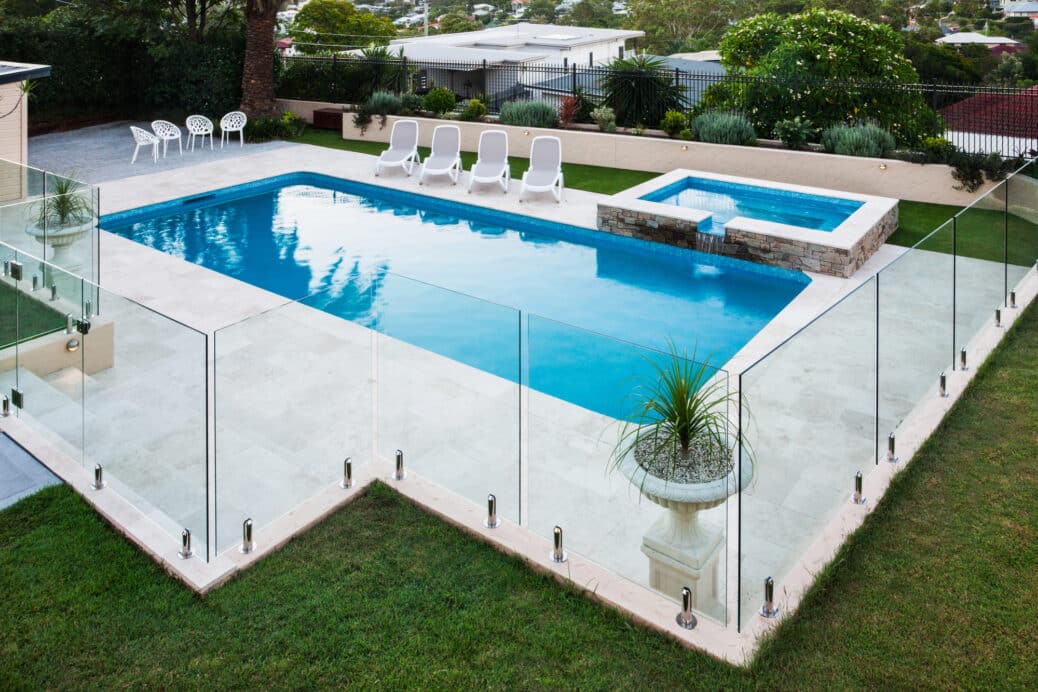
Every Perth summer brings the same round of warnings about pool safety, and most of us nod along and go back to what we were doing. The barrier is up, it passed inspection at some point, and that feels like the job is done.
It isn’t, and the reason is uncomfortable. A pool barrier that was fully compliant on the day it was installed can quietly stop being compliant years later without anyone touching it. Plants grow. Furniture moves. A latch wears. A boundary fence gets replaced. None of that feels like a safety change, and all of it can be.
Here is what the law actually requires in Western Australia, where barriers most commonly fail, and the ten-minute check worth doing yourself.
The law, briefly
In WA, pool barriers are governed by the Building Act 2011 and the Building Regulations 2012, with the technical requirements set out in Australian Standard AS1926.1.
The threshold that catches people out is the depth. All private swimming and spa pools that hold water more than 300mm deep must have a compliant safety barrier. That is 30 centimetres, which is far shallower than most people assume, and it captures above-ground pools, inflatable pools and portable pools as well as permanent ones.
The practical implication for families: a shell pool or inflatable set up in the backyard for summer is subject to the same law as a built-in pool. If it can hold water more than 300mm deep, it needs a compliant barrier or it needs to be emptied and put away after every use.
Local governments are required to inspect private pool barriers at least once every four years, and if four years pass without a check, that pool is recorded as overdue. Councils have become considerably more active about this, with some using aerial photography to identify bodies of water in backyards.
Penalties are real. The City of Melville, for example, lists a $1,000 infringement for a non-compliant enclosure under the Building Regulations 2012.
One more thing worth knowing: the requirements have changed over the years, so the standard that applies to your barrier can depend on when your pool was built or approved, with pools installed before 1 May 2016 assessed differently from newer ones. If you bought an older home with an existing pool, do not assume the barrier meets the current standard just because it exists.
Where barriers actually fail
Inspectors see the same handful of problems over and over. Almost none of them involve the fence itself falling down.
The gate
This is the number one failure, by a wide margin.
A compliant pool gate must swing outward, away from the pool, and it must close and latch by itself from any open position. Not from halfway. From fully open, released with no push.
Gates fail this test for mundane reasons. The self-closing hinge loses tension over a few years. The gate drops slightly on its hinges as the post settles, so it now catches on the latch instead of engaging it. Someone adjusted it to stop it slamming. A wheelbarrow gets left where it stops the gate swinging fully.
The other gate failure is the one nobody thinks of as a failure: propping it open. On a hot Saturday with people coming and going, a gate propped open is the single most dangerous thing in the backyard, and it happens in almost every household at some point.
The non-climbable zone
This is the requirement that trips up the most families, because it changes over time without you doing anything.
The rules require a zone on the outside of the barrier to be kept clear of anything a small child could climb. That zone is measured in an arc from the top of the fence, and it means the area near your pool fence has to stay free of footholds.
Things that create a foothold, all of which have caused failed inspections:
- Pot plants and garden beds built up near the fence
- Outdoor furniture, especially chairs and benches
- Bins, boxes, esky, toy storage
- Air conditioning units and pool pump housings
- Retaining wall edges and steps
- BBQs and outdoor kitchen units
- Trees and shrubs that have grown since the last inspection
That last one is the quiet killer. A shrub planted at knee height four years ago is now a climbing frame. Nothing about the fence changed, but the barrier is no longer compliant.
Horizontal rails on the outside face of the fence count too, which is why pool barriers use vertical elements with the structural rails on the pool side.
Gaps and spacing
There are limits on the vertical gaps between fence elements, the gap under the bottom of the fence, and the gap between the gate and the post.
The under-fence gap is the one that changes over time. Soil erodes, mulch settles, a dog digs, a garden bed is re-levelled. A gap that was compliant becomes a gap a determined toddler can get under.
Check the bottom of the entire barrier, not just near the gate.
The boundary fence problem
If part of your pool barrier is also a boundary fence shared with a neighbour, replacing that fence affects your pool compliance.
This catches people constantly. A neighbour organises a new dividing fence, it goes in at a standard height and specification, and it is not built to pool barrier requirements. The pool is now non-compliant and the owner has no idea.
If any part of your pool barrier is a shared boundary, tell your fencing contractor that before the work starts, and check the barrier again afterwards. Any residential fencing Perth job that touches a pool enclosure should be quoted with the barrier standard in mind, which is how FencrGatr scopes them.
Doors and windows
Where a house wall forms part of the barrier, any door or window opening into the pool area is subject to requirements too. Windows that can open more than a limited amount, or doors without compliant self-closing hardware, will fail.
This applies particularly to older homes where a pool was added later and the house wall was used as one side of the enclosure.
The ten-minute check
Do this at the start of every summer, and after any landscaping, fencing or renovation work.
- Open the gate fully and let go. It should swing closed and latch on its own. Do this three times. If it fails even once, the hinge or the latch needs attention.
- Try the latch from the outside at child height. A compliant latch cannot be reached and released by a small child from outside the barrier.
- Walk the outside of the barrier and look for climbable objects. Stand back and look at it the way a determined three-year-old would. Anything that could be stood on, near the fence, is a problem. Move it.
- Look at the plants. Specifically, look at anything you planted more than two years ago. Has it grown into a ladder?
- Check the bottom gap along the whole run. Soil movement, erosion and mulch changes create gaps over time.
- Check the gaps between vertical elements, especially anywhere a panel has been repaired or replaced.
- Push the fence. Firmly, at the top, at several points. Any give at ground level means a post footing is deteriorating.
- Check any doors or windows that open into the pool area still have working compliant hardware.
If anything fails, deal with it now rather than waiting for the council letter. The check is about the four-year-old in your house this weekend, not the inspection in eighteen months.
When the council letter arrives
Councils send reminder letters when an inspection is due, and typically ask you to book within a short window. Book it. Access difficulties are a leading reason pools go overdue, and an overdue pool is on a list.
Before the inspector comes, do the ten-minute check yourself and fix what you find. It is far cheaper to move a pot plant than to fail an inspection, arrange remediation and book a re-inspection.
If you do fail, be aware that the fix is sometimes structural rather than cosmetic, particularly on older barriers built to a superseded standard. Getting a proper assessment before spending money is worth it, because a barrier can be brought up to compliance in more than one way and the cheapest fix is not always available.
If you are putting in a new barrier
Two things are worth getting right at the design stage rather than after.
First, plan the non-climbable zone as part of the landscaping, not against it. Decide where the pot plants, furniture and pool equipment are going before the fence goes in, and keep that zone clear by design. Retrofitting compliance into a finished landscape means pulling out plants you paid for.
Second, coordinate the pool barrier with any boundary fencing at the same time. A Colorbond fencing installation quote and a pool barrier quote handled by the same contractor, as FencrGatr does, avoids the situation where one job quietly breaks the other. If a shared boundary forms part of the barrier, it needs to be built to the barrier standard from the outset, and the neighbour conversation about cost sharing is easier before anything is built.
The thing to actually remember
Pool barrier compliance is not a one-off event that you passed in 2021. It is a condition that drifts, and the two things most likely to break it are a gate that has lost its self-closing tension and a plant that has grown.
Both take about two minutes to check. Both have contributed to drownings.
If something needs fixing, FencrGatr builds and certifies barriers to AS1926.1 across the metro area. But the walk itself costs nothing.
Do the walk this weekend.